
The Timeless 80/20 Rule, Proven Across 2,000 Years

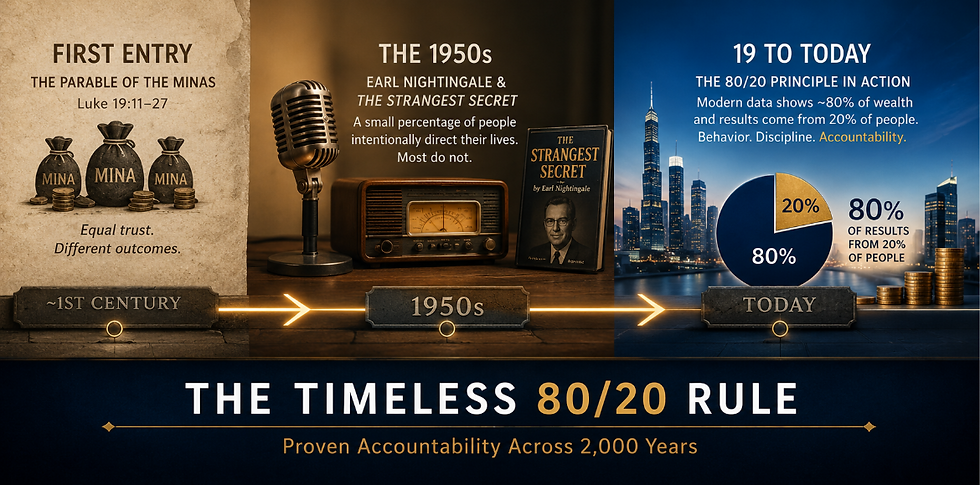
The Timeless 80/20 Rule, Proven Across 2,000 Years
Opening Thought
Today, economists often point to the 80/20 rule.
A small percentage of people typically produce a disproportionate share of results, wealth, leadership, innovation, and long-term progress.
Modern retirement data reflects this reality clearly. A relatively small percentage of households hold the majority of retirement assets, not necessarily because they earned dramatically more, but often because they consistently followed behaviors repeated over decades:
Saving regularly
Living below their means
Staying invested
Avoiding emotional decisions
Seeking guidance
Remaining disciplined during uncertainty
Most people associate this principle with Vilfredo Pareto in the early 1900s or with modern business theory.
But the underlying idea is much older.
More than 2,000 years ago, Jesus told a story that mirrors many of the same observations about responsibility, stewardship, accountability, and outcomes.
Not through economics.
Not through spreadsheets.
Through behavior.
Ancient Roots of the 80/20 Principle
In Luke 19:11–27, often referred to as the Parable of the Minas, a nobleman entrusts servants with equal amounts of money before leaving on a journey.
Each servant starts at the same point.
When the nobleman returns, the outcomes are dramatically different.
One servant multiplied what was entrusted to him tenfold.Another produced fivefold growth.One did nothing at all.
The story is not centered on unequal opportunity.
It is centered on accountability.
What separated the outcomes was not merely talent, luck, or resources.It was action, responsibility, discipline, and stewardship.
In many ways, the story mirrors a pattern humanity has observed repeatedly throughout history:A minority of people consistently act with long-term discipline, while many drift without structure or intentionality.
Earl Nightingale and The Strangest Secret
Fast forward nearly 2,000 years.
In the 1950s, Earl Nightingale released a recording titled The Strangest Secret.
One of the core observations in the recording was simple:A relatively small percentage of people intentionally direct their lives, while most simply react to circumstances.
Nightingale famously observed that many people spend more time planning a vacation than planning their financial future.
The numbers themselves were never meant to be scientific precision.The principle was behavioral.
A small group consistently lives intentionally.
Most do not.
The Modern Version of the Same Story
Today, the numbers are easier to measure.
We can track savings rates, retirement balances, debt levels, investment participation, and long-term financial behavior.
And while income matters, behavior often matters more than people realize.
Over long periods of time:
Consistency usually beats intensity
Discipline often beats prediction
Structure tends to outperform emotion
Planning generally outperforms improvisation
This is why two families with similar incomes can end up in dramatically different financial positions twenty years later.
The difference is often not intelligence.It is a repeated behavior.
The Real Divider Is Accountability
The Parable of the Minas introduces a difficult but important idea: People are accountable for what they do with what they have been given.
Not everyone starts in the same place.
Not every outcome is controllable.
Life includes hardship, setbacks, and unfairness.
But over long periods of time, behavior still matters.
Financially, this accountability often looks like:
Having a written plan
Saving before spending
Diversifying instead of gambling
Seeking counsel before major decisions
Staying disciplined during fear and greed
Thinking long term instead of reacting short term
These are rarely exciting decisions.
But over decades, they become powerful.
Why This Matters Today
Technology has made information nearly unlimited.
But information alone does not create wisdom or discipline.
If anything, modern life often amplifies distraction, comparison, impulsiveness, and short-term thinking.
The challenge today is not access to information. It is the ability to apply consistent principles over long periods of time.
That may be why the same behavioral patterns continue appearing generation after generation.
Different economies.
Different technologies.
Different centuries.
The same human tendencies.
Closing Thought
The 80/20 rule is often discussed as a business principle or economic observation.
But at its core, it may simply reflect something timeless about human behavior:
A relatively small percentage of people consistently live with intentionality, discipline, and accountability over long periods of time.
That was true in the first century. It was true in the 1950s. And it still appears true today.
The question is not whether the pattern exists.
The more important question is:
Which group are we preparing ourselves to become part of?
Disclosure - All written content on this site is for information purposes only. Opinions expressed herein are solely those of Core Wealth Consultants, LLC and our editorial staff. Material presented is believed to be from reliable sources, however, we make no representations as to its accuracy or completeness. All information and ideas should be discussed in detail with your individual adviser prior to implementation. Core Wealth Consultants, LLC a Registered Investment Advisor in the States of Florida, Indiana and Michigan. The presence of this web site shall in no way be construed or interpreted as a solicitation to sell or offer to sell investment advisory services to any residents of any State other than the States of Florida, Indiana, Michigan or where otherwise legally permitted. Content should not be viewed as an offer to buy or sell any of the securities mentioned or as legal or tax advice. You should always consult an attorney or tax professional regarding your specific legal or tax situation. Core Wealth Consultants, LLC is not engaged in the practice of law. Hyperlinks on this website are provided as a convenience. We cannot be held responsible for information, services or products found on websites linked to ours. Diversification and asset allocation does not assure or guarantee better performance and cannot eliminate the risk of investment loss.
© 2024 All Rights Reserved - PlanAssist®


Comments